

TARIFFS IN 2025: RISKS AND IMPLICATIONS FOR YOUR PORTFOLIO
As tariffs dominate headlines once more, investors face heightened uncertainty. Intended to protect domestic industries and create leverage in trade negotiations, tariffs can also introduce economic headwinds. In this issue of Investment Insights, we examine how tariffs affect the economy, businesses, and your investments.
UNDERSTANDING TARIFFS
Tariffs, according to Merriam-Webster, originate from the Italian tariffa, meaning a list of fees or charges. Their history dates to Ancient Greece, where Athens imposed a 2% levy on imports through the Piraeus port to generate government revenue and control trade.1
A straightforward way to understand tariffs is through an example: Imagine Country A and Country B. Country A produces affordable, high-quality cars, which are popular among consumers in Country B. Because of this, local car manufacturers in Country B struggle to compete. To protect its domestic industry, Country B imposes a 30% tariff on cars imported from Country A, increasing the price of an imported car from $20,000 to $26,000. This makes locally made cars more competitive, benefiting manufacturers in Country B, but it also forces consumers to pay higher prices as the cheaper cars from Country A now cost more. While tariffs can protect local industries and jobs, they can also increase costs for consumers.
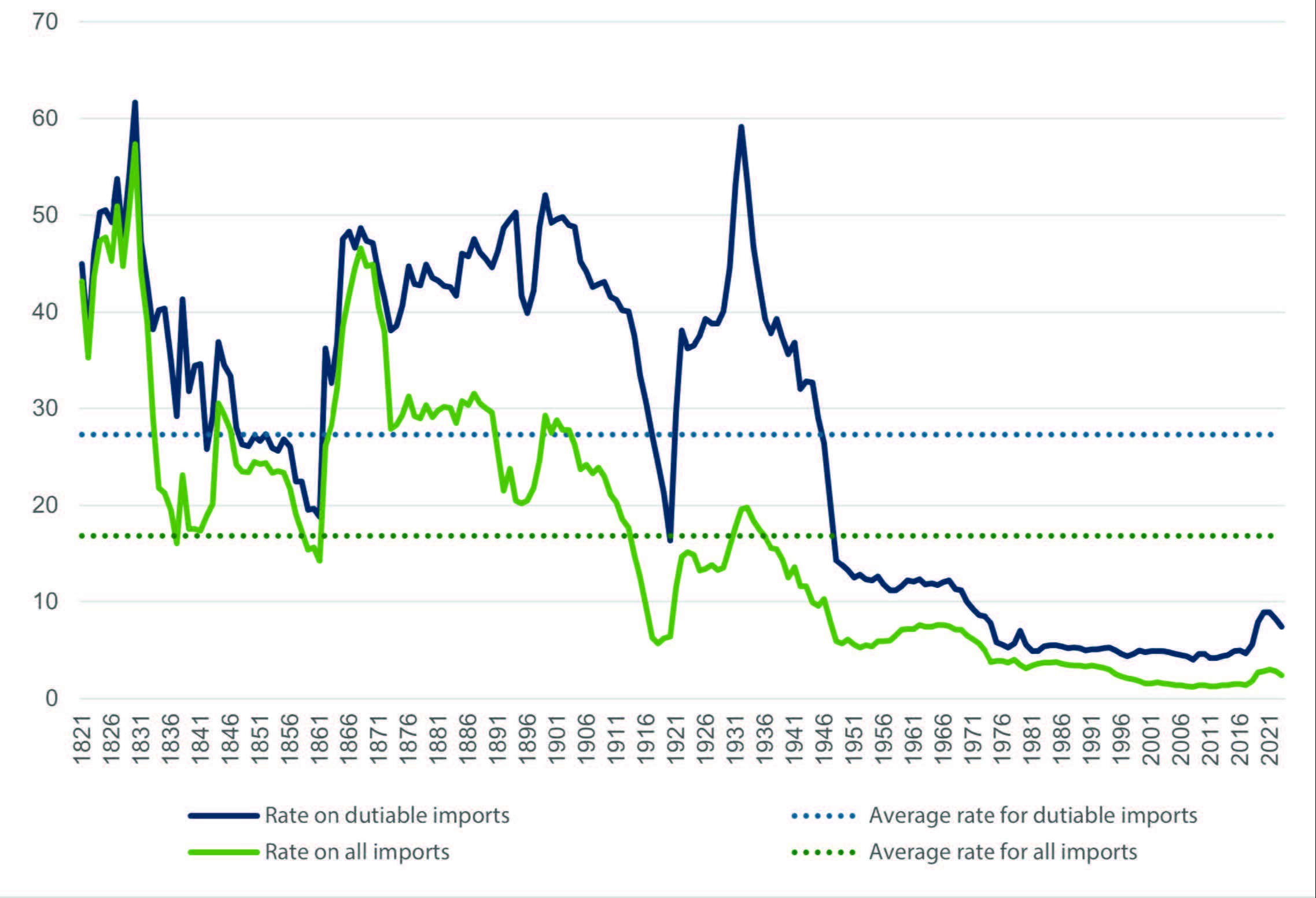
Historically, as shown on pg. 2, U.S. tariff rates were high during the 19th and early 20th centuries, peaking with the Smoot-Hawley Tariff Act of 1930, which imposed an average duty of 59.1% on dutiable imports.2 Following World War II, a shift towards trade liberalization led to a significant reduction in
tariffs, which reached some of the lowest levels in U.S. history by the late 20th century.
ECONOMICS OR POLITICS?
Tariffs are often portrayed as economic tools designed to protect domestic industries, regulate trade balances, and generate government revenue. However, political motivations frequently drive their implementation, making them a key instrument in global power struggles and strategic trade negotiations. Economists typically argue that tariffs reduce global welfare by creating inefficiencies, distorting markets, and limiting the benefits of free trade. When countries impose tariffs, they raise the cost of imported goods, which can lead to inflationary pressures, decreased consumer purchasing power, and disruptions in supply chains. For example, a study by Furceri et al. examined the economic impact of tariffs across 151 countries over several decades and found that even modest increases in tariff rates negatively affected GDP growth.3 Specifically, their analysis revealed that a 3.6-percentage-point rise in tariffs corresponded to a 0.4% GDP decline over five years, demonstrating how protectionist policies can slow economic expansion and reduce overall productivity by discouraging competitive efficiencies and innovation.
However, the economic consequences of tariffs are not uniform across all nations. Some studies suggest that larger economies with substantial bargaining power can benefit from imposing tariffs, especially when they dominate key global industries. A study by Kennan and Riezman found that large economies can leverage tariffs to influence global trade terms, securing preferential advantages despite retaliatory measures from trade partners.4 Countries with strong domestic markets and diverse economies may withstand the effects of tariffs better than smaller, export-dependent nations.
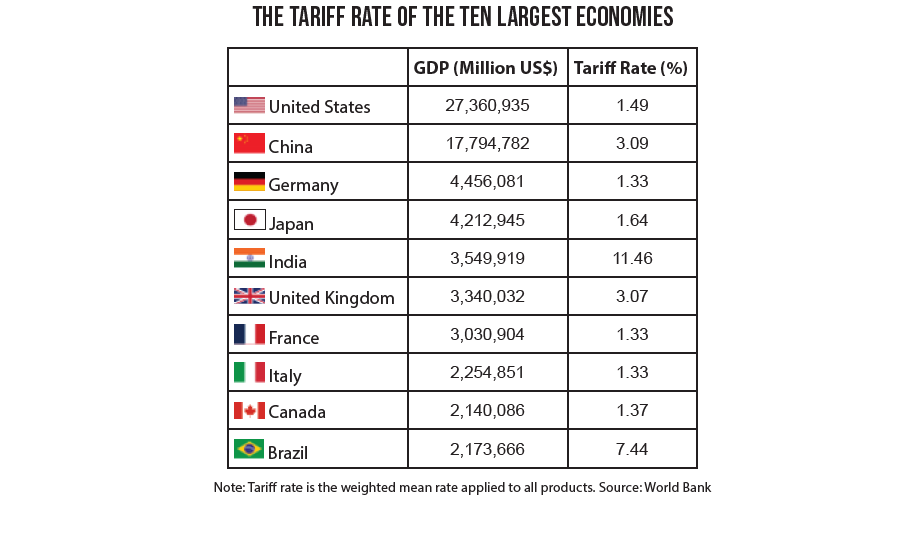
On the political front, the variation in tariff rates among major economies, as highlighted above, shows how governments use trade policies as strategic instruments to shape diplomatic and economic relationships. As shown in the data, some countries, like India (11.46%) and Brazil (7.44%), maintain significantly higher tariff rates, signaling a strong protectionist approach aimed at shielding domestic industries from foreign competition and promoting local production. High tariffs in these nations can be driven by factors such as domestic job protection, revenue generation, and reducing reliance on imports, particularly in sectors deemed critical for national economic security. This approach aligns with the broader political strategy of self-sufficiency and economic nationalism, where countries seek to strengthen their internal markets and reduce foreign dependence, even at the cost of higher consumer prices.
In contrast, economies such as the United States (1.49%), Germany (1.33%), and France (1.33%) maintain relatively low tariff rates, reflecting a commitment to free trade and global market integration. These countries benefit from extensive trade networks and established industrial capabilities, making them less reliant on protectionist measures. Instead, they often leverage non-tariff barriers, such as subsidies, quotas, and stringent regulatory standards, to maintain economic influence without directly increasing tariff rates.
Meanwhile, China (3.09%) and the United Kingdom (3.07%) implement moderate tariffs, striking a balance between trade liberalization and protecting national interests. China, as the world’s second-largest economy, strategically adjusts its tariff policies to retain a competitive advantage while controlling key industries like manufacturing and technology. Similarly, the United Kingdom, post-Brexit, has had to redefine its trade relationships, using tariffs selectively to protect domestic businesses while fostering new international trade agreements.
ECONOMIC FORECAST
Predicting the economic impact of tariff policies is inherently tricky due to the many moving parts and assumptions involved. Factors like the tariff rate, the duration of enforcement, and the ripple effects from potential retaliatory actions by other nations are constantly shifting. This fluidity makes any single economic forecast unreliable and often outdated by the next news cycle. However, to illustrate the potential outcomes, let’s consider a scenario where 25% tariffs are applied to imports from Canada and Mexico, alongside a 10% tariff on goods from China. Note that while this scenario, as calculated by the Tax Foundation, may offer insight, it shouldn’t be viewed as a fixed prediction but rather as a way to examine the potential impact of the economy.
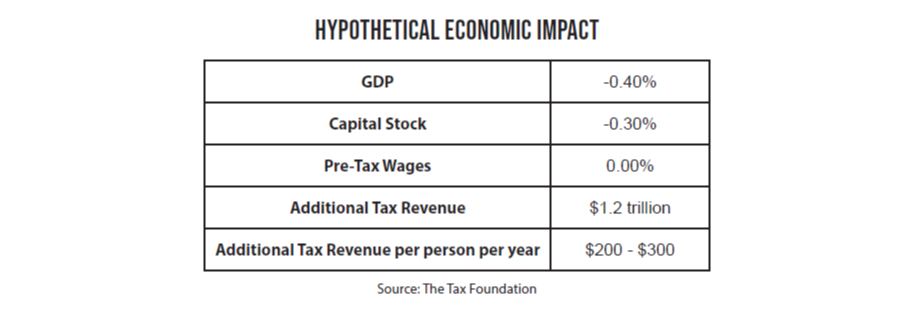
The tariff policy scenario, as illustrated in the table above, highlights a mix of pros and cons for the U.S. economy. On the positive side, tariffs can boost government revenue, as evidenced by the estimated $1.2 trillion increase in federal tax revenue between 2025 and 2034. They also provide temporary protection to domestic industries, potentially safeguarding jobs and allowing certain sectors to recover or expand without facing direct foreign competition. However, the potential downsides are also significant. The policy is expected to shrink long-term GDP by 0.4% and reduce the capital stock. Overall, while short-term gains in government revenue and industry protection are possible, long-term impacts can slow economic growth.
IMPACT ON INVESTMENTS
Tariff-related volatility in markets may persist, but investors should maintain perspective and avoid overreacting to short-term fluctuations. While new tariffs often trigger initial market sell-offs and currency adjustments— such as a stronger U.S. dollar impacting exports—these events historically tend to be temporary. Instead of making significant portfolio changes based on immediate reactions, investors are encouraged to focus on longterm fundamentals and diversification. Understanding that tariffs may contribute to inflationary pressures and supply chain disruptions, a balanced and informed approach will help ensure they stay on your financial plan without being swayed by short-lived market noise.
1 Encyclopedia of Ancient Greece, edited by Nigel Wilson
2 Foundation for Economic Education
3 Does Trade Protectionism Affect Economic Growth? by Davide Furceri, Swarnali A. Hannan, Jonathan D. Ostry, and Andrew K. Rose, Journal of Policy Modeling
4 Do Big Countries Win Tariff Wars? by John Kennan and Raymond Riezman, Journal of International Economics
Important Disclosures: The information contained in this report is as of January 30, 2025 and was taken from sources believed to be reliable. It is intended only for personal use. To obtain additional information, contact Cornerstone Wealth Management. This report was prepared by Cornerstone Wealth Management. The opinions voiced in this material are for general information only and are not intended to provide specific advice or recommendations for any individual. To determine which investment(s) may be appropriate for you, consult your financial advisor prior to investing. Investing involves risk including the potential loss of principal. No strategy can assure success or protection against loss.
There is no guarantee that a diversified portfolio will enhance overall returns or outperform a non-diversified portfolio. Diversification does not protect against market risk. Securities offered through LPL Financial, member FINRA/SIPC. Investment advice offered through Cornerstone Wealth Management LLC, a registered investment advisor and separate entity from LPL Financial.